
THE END OF FRICTION
Non-Friction Braking System.
Euro-7 Compliant.
Zero Emissions.
RSS-HOOK™: Converting Kinetic Energy into Elastic Potential.
Introduction
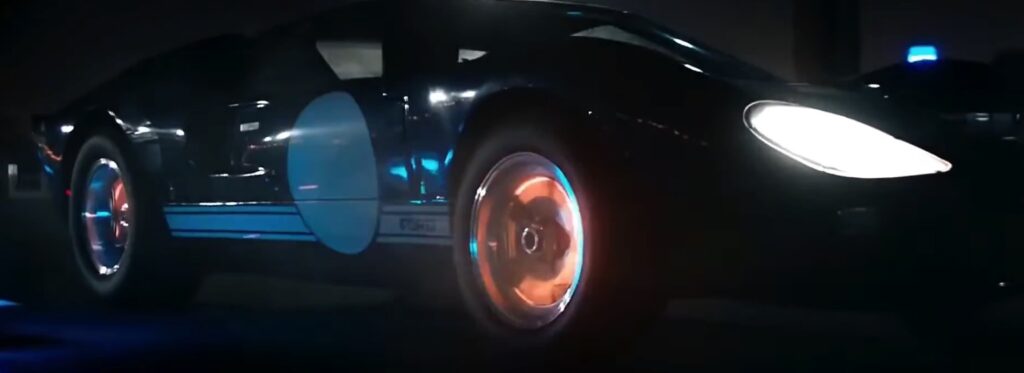
Invention No. AP 2020 15436 introduces a breakthrough mechanical solution: the Brake Device — a braking unit without pads and without dry sliding friction.
This is not merely an invention, but a paradigm shift in mechanical braking. For the first time in over 5,500 years — since the invention of the wheel — a mechanical brake has been developed that operates without traditional brake pads and without dry sliding friction.
The author of the discovery is Academician RAMZAN GOYTEMIROV.
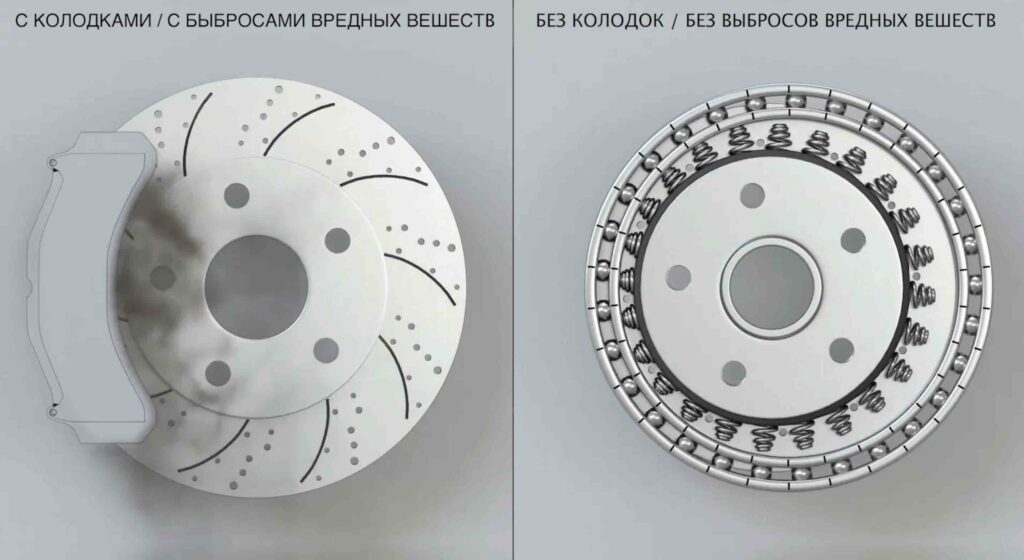
The system replaces conventional friction-based contact with an alternative mechanical principle, fundamentally redefining how braking force is generated. Dry sliding friction between pad and disc is completely eliminated. Instead, the mechanism utilizes rolling friction through a bearing-based system, transforming the physics of braking at its core.
A working prototype has been manufactured and successfully tested, confirming the viability and performance of the concept.
A New Approach to Mechanical Braking
Conventional braking mechanisms face inherent limitations caused by dry sliding friction. Effective deceleration requires rough contact surfaces between friction pairs — traditionally, brake pads and a disc. This contact generates heat, wear, noise, and dust, which ultimately limit durability and efficiency.
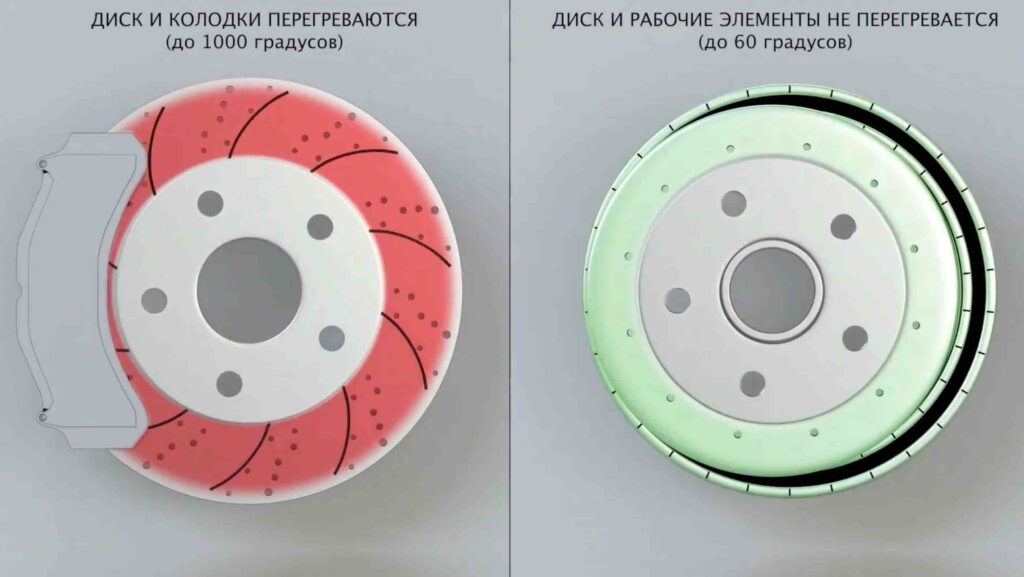
We present a braking device that eliminates dry sliding friction entirely. The system operates without brake pads and replaces sliding friction with rolling friction through a bearing-based mechanism. It can be fully sealed from the external environment and is capable of operating in an oil medium without overheating.
The result is a braking process that is:
Quiet — no operational noise
Clean — no brake dust
Smooth — no jerks or abrupt engagement
The service life of the device significantly exceeds that of conventional braking systems — by at least 10 times for heavy-duty vehicles and up to 30 times for passenger vehicles.
The system enables controlled deceleration and stable speed maintenance on downhill gradients. Its operation can be mathematically modeled and integrated with an electronic control unit to automatically regulate and maintain a required or optimal speed.
Unlike traditional systems, the device independently regulates the braking process and performs functionality comparable to ABS. Its principle is based not on brake release (wheel unlocking), but on synchronized braking control.
A complete development cycle has been carried out, including research and engineering design, detailed component development, testing of assemblies and individual elements, and full-scale testing of an experimental prototype. Operational performance and efficiency have been successfully validated.
The braking device is designed for universal application across all types of transport systems. It provides mechanical deceleration and speed stabilization without sliding friction, regardless of vehicle weight or operating conditions, and without the need for additional bulky auxiliary units such as an intarder.
Executive Summary of the Invention
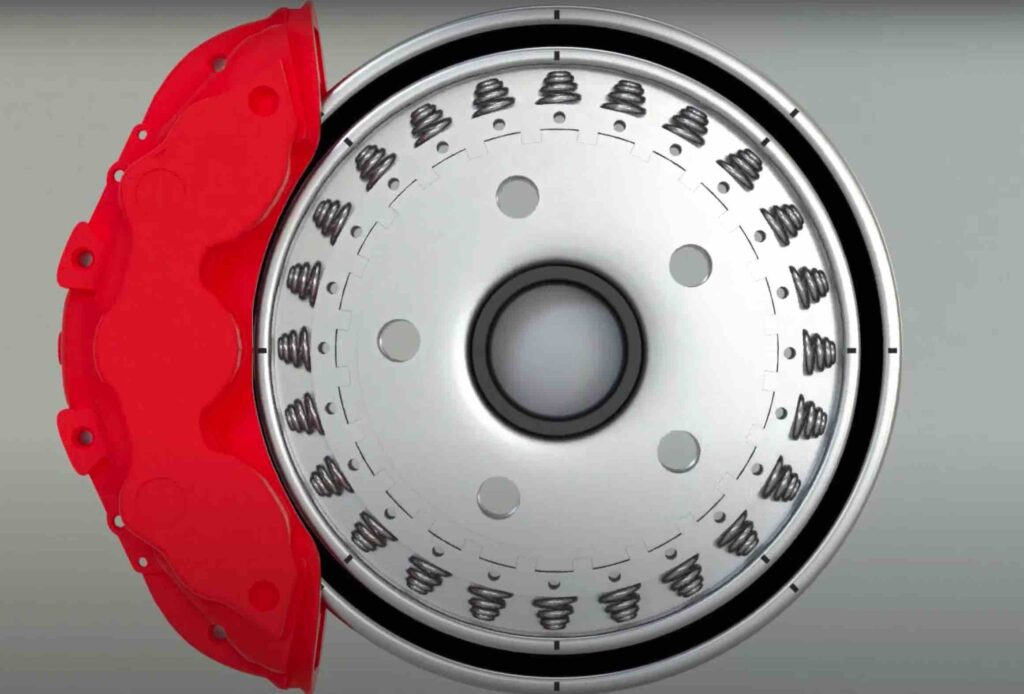
Core Concept
Braking is achieved without conventional brake pads and without traditional “pad-to-disc” contact.
The system can operate in a sealed configuration, including within an oil medium, preventing overheating and eliminating dust generation.
Key Advantages
Braking is achieved without conventional brake pads and without traditional “pad-to-disc” contact.
The system can operate in a sealed configuration, including within an oil medium, preventing overheating and eliminating dust generation.
Development Stage
- R&D completed.
- Engineering design finalized.
- Experimental prototype manufactured and tested.
- Performance validated through trials
Economic and Environmental Impact
- Reduced brake system weight (up to 60–70% for heavy vehicles).
- Lower operating and maintenance costs.
- Elimination of brake dust emissions.
- Increased reliability
Conclusion
This project is positioned as a mechanical alternative to conventional disc brakes, eliminating the primary structural limitation of traditional systems—dry sliding friction.
It offers a substantial increase in durability, environmental sustainability, and operational safety.
THE DEAD END OF FRICTION

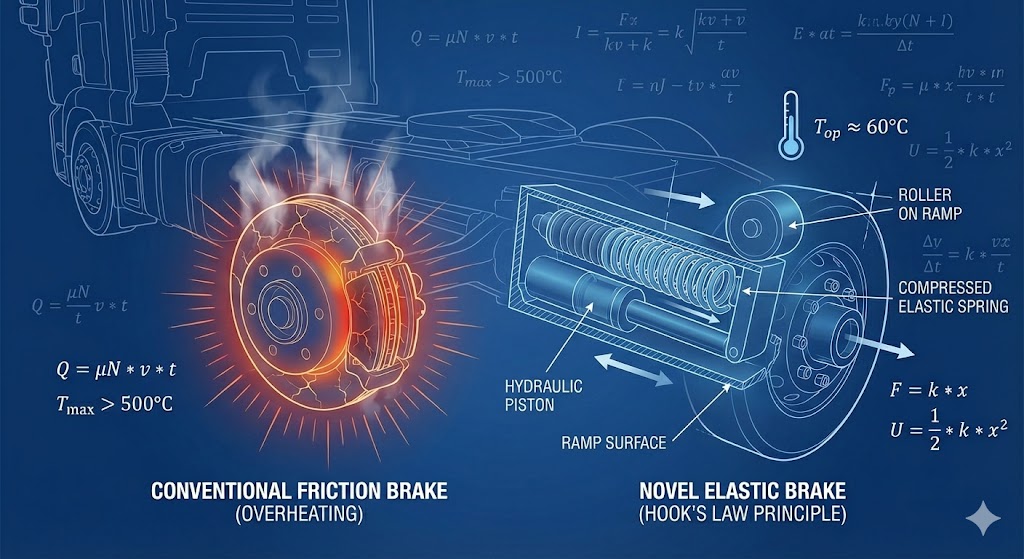
For over a century, heavy vehicle braking meant destruction. Traditional retarders and disc brakes work by converting motion into Heat and Toxic Dust. This technology has reached its physical limit.
1. THE EURO-7 WALL
New EU regulations declare brake dust a particulate pollutant. Friction brakes are now a liability for every OEM manufacturer.
2. THE THERMAL TRAP
Friction relies on heat dissipation. On long alpine descents, overheating leads to «brake fade» and catastrophic failures.
3. THE WEIGHT PENALTY
Standard hydrodynamic retarders weigh 150kg+. That is dead weight eating into fuel efficiency and payload revenue.
PURE PHYSICS. NO MAGIC.
«We replaced friction with Hooke’s Law (F=−kx). Instead of rubbing pads against a disc, the RSS-HOOK system stretches a sealed elastic element. The energy is absorbed by the material structure, not by surface friction.»
SEALED UNIT
No dust can escape. Emission: 0.00 mg/km.
COLD OPERATION
Effective even on infinite descents. No overheating.
FEATHERWEIGHT
Total system weight: ~30 kg (5x lighter than competition).
TECHNICAL COMPARISON
| PARAMETER | RSS-HOOK™ (VIDAL) | STANDARD RETARDER |
|---|---|---|
| System Weight | ~30 kg | 120 - 180 kg |
| Particulate Emissions | 0.00 mg/km (Sealed) | High (Open Friction) |
| Thermal Fade | Zero (Cold) | Critical Risk |
| Maintenance | 500,000 km | Regular Replacement |
INTELLECTUAL PROPERTY PROTECTED: PATENTS US, EU, DE.
REQUEST TECHNICAL DATA